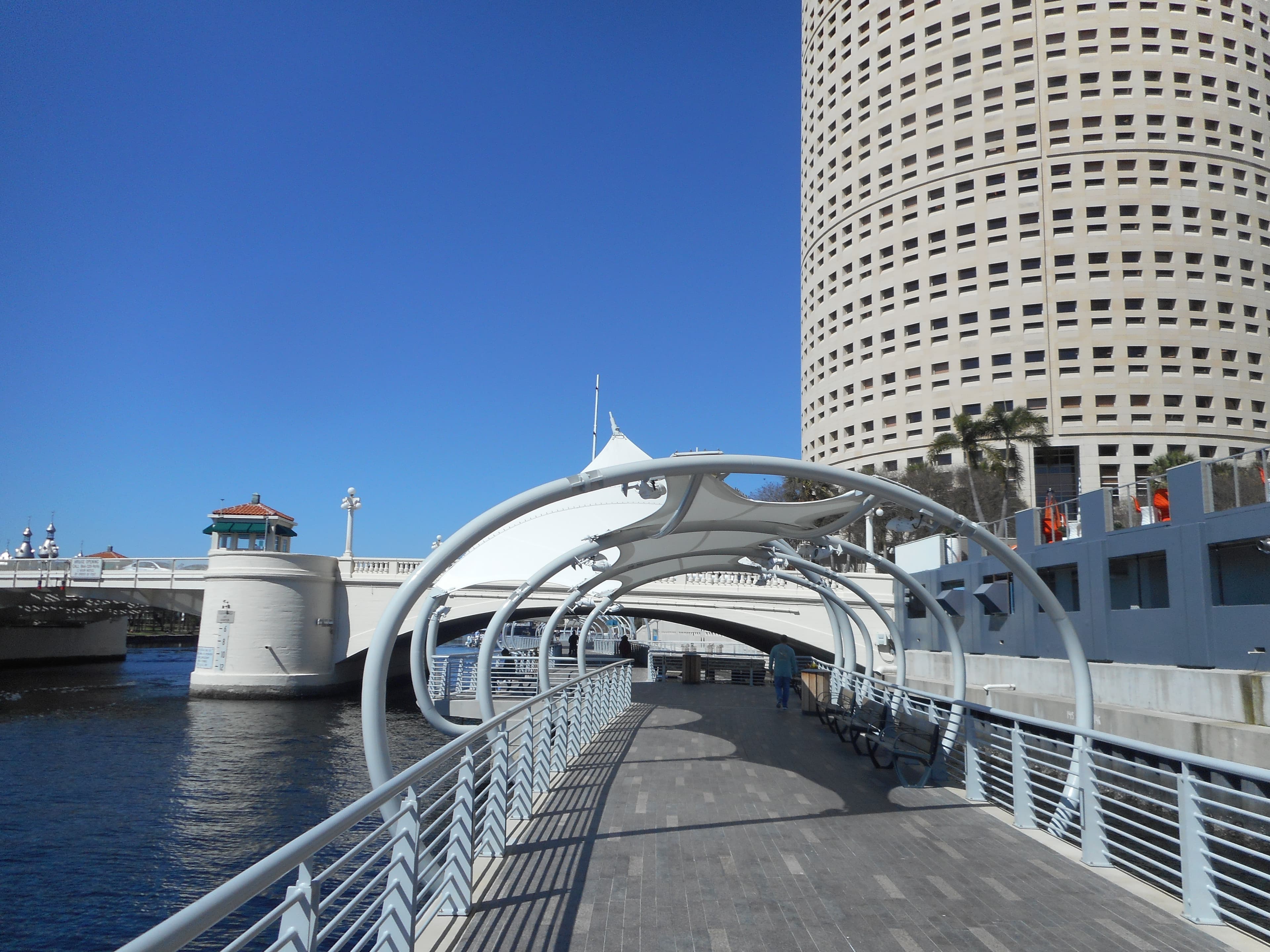
The Riverwalk.
Contemporary execution — segmented build, compounded impact.
the corridor before
Before
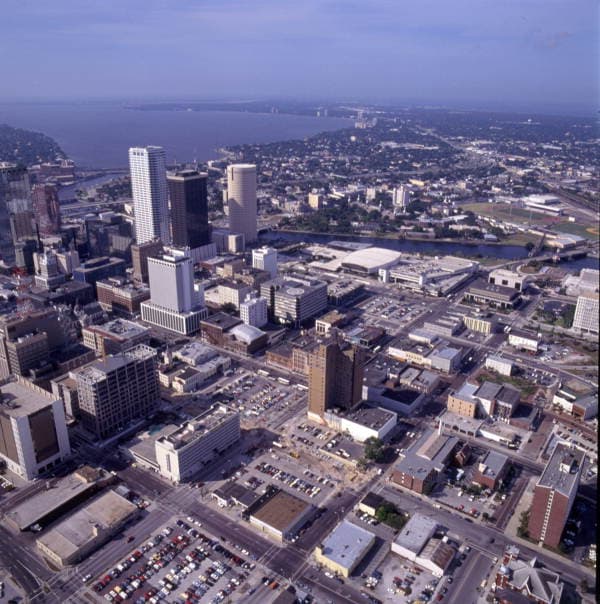
The Tampa Riverwalk story begins with an arresting fact about who actually lived downtown. In 1980, the entire downtown core held roughly 600 residents — and roughly half of them were inmates in the Morgan Street jail. The waterfront along the Hillsborough River was a strip of derelict warehouses, demolished industrial parcels, and surface parking lots tied to the nearby Port of Tampa. There was no continuous public access to the river from the downtown core, and at least one city park along the water sat fenced and padlocked. Tampa’s once-massive streetcar system — carrying 24 million annual riders at its peak — had been dismantled by the 1940s and replaced by a car-oriented grid that pushed pedestrians inland, away from the water.
Downtown Tampa had roughly 600 residents in 1980— and roughly half of them were inmates in the Morgan Street jail.
— Tampa Downtown Partnership, “How Tampa Turned a Dead Zone Into a Downtown,” 2018
The Riverwalk concept was first proposed in 1975 by Mayor Bill Poe, who saw it as a Bicentennial project — a wooden, pier-style boardwalk funded by individual donors who could buy a plank engraved with their names. Poe later admitted the original effort never got past the tokens. “I tried to do it 40 years ago,” he told WUSF in 2013. “I think I put about 10 planks in and I had to buy the planks.” A short stretch of boardwalk went in near Curtis Hixon Hall in 1976, then the project stalled for funding and political reasons almost immediately.
Through the 1980s and early 1990s, downtown Tampa’s energy went into marquee public buildings rather than the river itself. Under Mayor Sandy Freedman(1986–1995) the city built the Tampa Convention Center, the Florida Aquarium (opened 1995), and the Ice Palace arena — almost entirely with public money. Each carried a small waterfront walkway, but they did not connect to one another. Freedman herself later named the era’s central failure plainly: “Everybody had turned their back on the river.”
In 1989, during Dick Greco’s first non-consecutive term, the wooden Bicentennial planks at Curtis Hixon were replaced with permanent granite pavers and a ramp went in at Rivergate Tower. But budget constraints through the 1990s — Greco’s second tenure ran 1995–2003 — meant most of the work stayed incidental. Each new building project bolted on its own small piece of waterfront walkway, and the connections between them were never made. By the late 1990s, downtown Tampa was a collection of waterfront destinations — the Convention Center, the Marriott Waterside (2000), the Performing Arts Center (1987) — that you could not actually walk between along the water.
The pre-2007 condition is worth pausing on because it sounds extreme but was widely documented. Downtown retailers had decamped to the suburbs. The Channel District east of the arena was an industrial dead zone of fenced lots. Future mayor Bob Buckhorn, in his later framing, described the pre-2003 waterfront flatly as “a dump.” Tampa was the textbook American Sunbelt downtown of the late twentieth century — a place that had built convention infrastructure and an aquarium and an arena and was waiting in vain for those isolated attractions to add up to a place. The river ran through the middle of all of it, unwalked.
That is the condition the next four mayors inherited: not a contested piece of infrastructure to be saved or demolished, as on the High Line, but a public realm asset that existed only in fragments and had never been assembled. The political problem was not opposition. It was continuity — whether four consecutive administrations would treat a forty-year-old plank-by-plank idea as a coordinated public project rather than an afterthought attached to whatever building happened to get built next.
decision, timeline, cost
Build
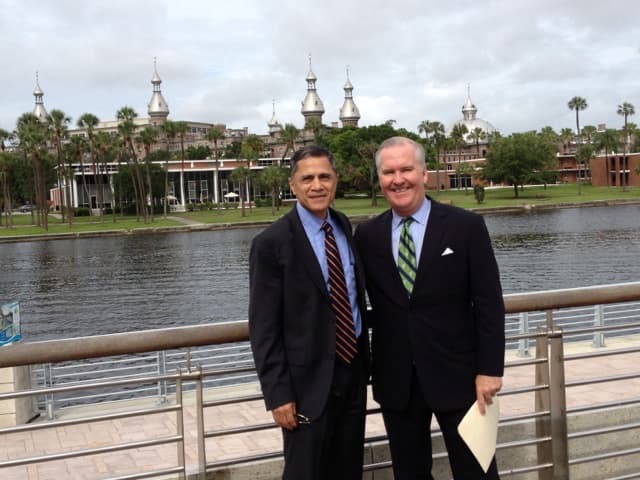
The Riverwalk was not built as a unified project. It was built as a sequence of independently funded, independently scoped segments stitched together over twelve years under three consecutive mayors, with a fourth — Greco — supplying the political continuity from the prior generation. This is the single most transferable fact in the case, and it is the inverse of the megaproject model most cities reach for first.
The political turning point was 2002, when Pam Iorioran for mayor on a platform that explicitly included finishing the Riverwalk. She won. Construction began in 2003 on two parks behind the arena — Cotanchobee Fort Brooke Park opened that year — and a connecting path along the Garrison Channel. Her administration produced the Phase I Master Plan in 2006, the first time the segments were treated as a coordinated public realm rather than a collection of attached amenities. The Iorio-era segments came in steadily: MacDill Park in 2005; USF Park and the master plan in 2006; the Platt Street Bridge underpass in 2008; the Convention Center park extension and South Plaza in 2009; and in 2010 her signature project, Curtis Hixon Waterfront Park, with the new Tampa Museum of Art and the Glazer Children’s Museum.
By the time Iorio left office in 2011, the spine of the path was mostly there, but it had two gaps. The first was south of Curtis Hixon under the Kennedy Boulevard Bridge; the second was north of the Performing Arts Center, connecting to Water Works Park in Tampa Heights. These two gaps were the difference between a series of connected parks and a single continuous walkable corridor.
Closing them is what made Bob Buckhorn— who served 2011–2019 — “the mayor who built the Riverwalk.” Buckhorn applied for and secured a $10.9 million federal TIGER grant from the U.S. Department of Transportation in 2012; Tampa was one of 218 grants awarded from roughly 4,000 applications nationally. The grant funded the $9.2 million Kennedy Boulevard Plaza, a 1,460-foot cantilevered boardwalk over open water that filled the south gap. It opened in 2015. The northern gap to Water Works Park was closed in 2016, completing the 2.6-mile continuous corridor.
Total public cost of the Riverwalk through completion is most reliably reported at approximately $33 million spent over four decades. That figure stacks federal TIGER funds, city general fund and community redevelopment area contributions, a Tampa-Hillsborough County Expressway Authority partnership, and a roughly $20 million private engraved-paver campaign coordinated by the Friends of the Riverwalk, the nonprofit that emerged during the Iorio era. The decisive feature is what is missing from that ledger: no single capital line ever exceeded the $9–11 million federal grant that closed the final gap. There was no moment at which the city had to ask voters or a council to approve a nine-figure bond for a single object. Each segment was independently scoped, independently funded, and usable on opening day.
Buckhorn’s rhetorical framing of the completed corridor is the most useful piece of language Saint Paul can borrow. He repeatedly described the Riverwalk as the city’s living, breathing spine — the connective tissue that would activate every major downtown district at once.
The Riverwalk is the city’s living, breathing spine.
— Mayor Bob Buckhorn · Tampa Housing Authority, “The Impact of the Tampa Riverwalk,” 2022
At the corridor’s completion Buckhorn went further: “By all measures, it has completely transformed our city, and it may be one of the single-most important events in our community in probably the last 50 years.” At his 2018 State of the City he reframed downtown’s whole arc in two words — “We built this.” That same year the American Planning Association named the Riverwalk its 2018 “Great Places in America: People’s Choice” winner, beating four other finalists including the Detroit Riverfront and Washington’s Navy Yard. The language and the recognition did real work: they converted a piece of infrastructure into a piece of civic identity, and they did it before the private capital arrived, not after.
the arc through 2026
Compound
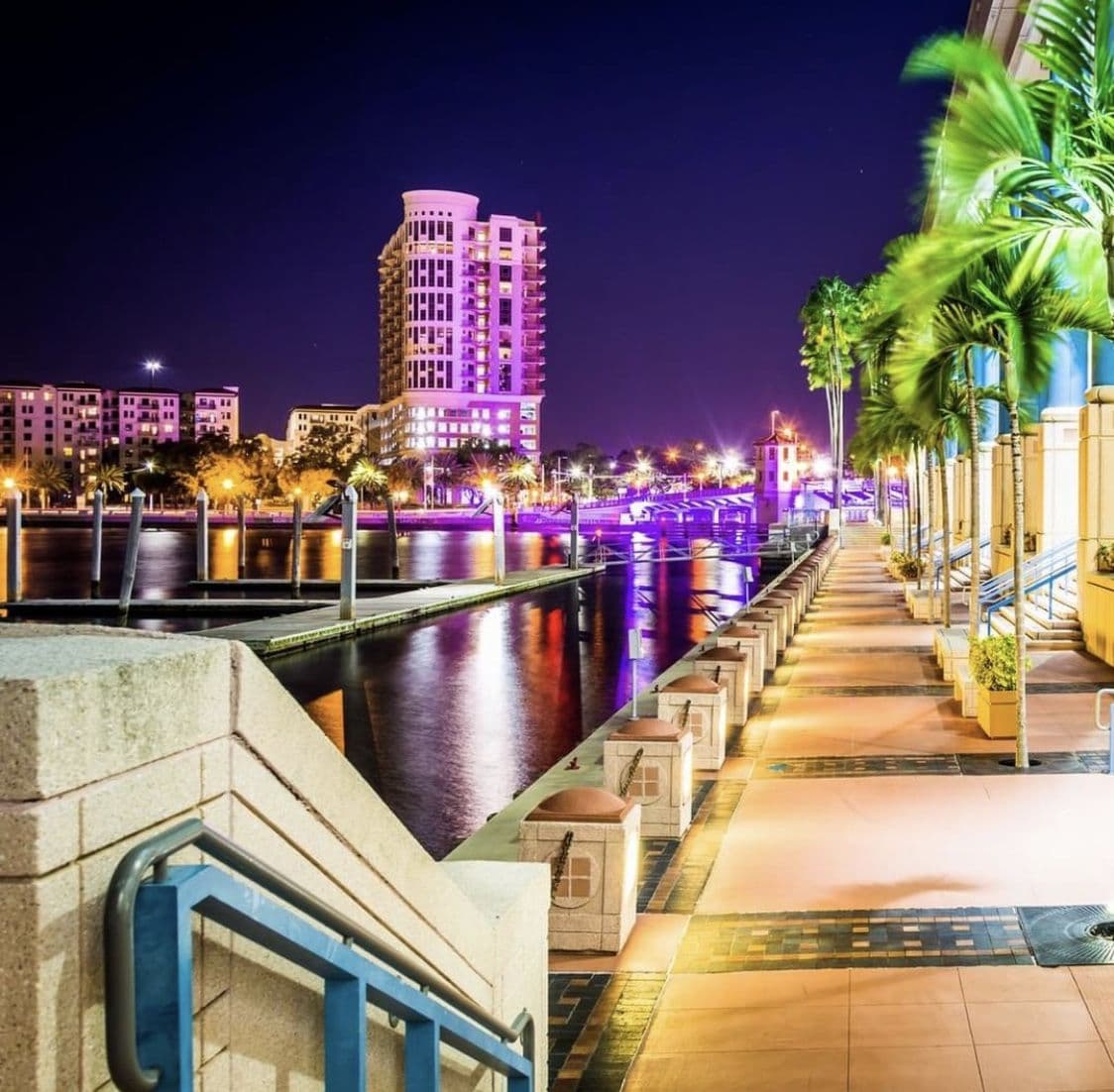
The Riverwalk’s completion in 2015–2016 lined up with — and arguably triggered — the largest private downtown investment boom in Tampa’s history. This is the cleanest “Bilbao effect” case American urbanism has produced in the last decade: a single linear public-realm asset that reset a downtown’s identity and unlocked private capital the previous twenty years of marquee buildings could not.
The headline is Water Street Tampa, a 53-acre, 16-block mixed-use district that wraps directly into the Riverwalk’s southern end. Water Street is developed by Strategic Property Partners, a joint venture between Tampa Bay Lightning owner Jeff Vinik and Cascade Investment— the personal investment fund of Microsoft co-founder Bill Gates, partnered with SPP since 2014. The original budget was $3 billion across nine million square feet: 3,500 residential units, 2.4 million square feet of office, a million square feet of retail and cultural space, two hotels, and the University of South Florida Morsani College of Medicine. The first-phase price tag rose to over $3.5 billion in subsequent reporting. Vinik began selling his share of SPP to Cascade in 2023; Cascade now controls the development long-term.
The public side of that ledger is the ratio Saint Paul should study. Public infrastructure investment in Water Street — separate from the buildings themselves — came to $50 million from the City of Tampa and $50 million from Hillsborough County in tax-increment financing, spent on street-grid redesign, sidewalks, drainage, and additional Riverwalk frontage. That is a $100 million public match against $3.5 billion in private capital. The broader downtown construction wave was estimated by Dodge Data & Analytics at roughly $13 billion in regional investment through 2022.
The Riverwalk-connected projects read as a near-continuous frontage. Sparkman Wharf(2018) repositioned the failed Channelside Bay Plaza into a waterfront food hall, beer garden, recreational lawn, and 180,000 square feet of office — marketed as the first project of the Water Street development. Armature Works (2018) repurposed a 1910 streetcar barn in Tampa Heights into a food hall anchoring the Riverwalk’s northern terminus. A run of waterfront residential towers — Manor Riverwalk, Riverwalk Place, Pendry, One Tampa — ranging from 32 to 55 stories were announced or under construction by 2022. Across the river, Buckhorn’s $35.5 million reconstruction of Julian B. Lane Riverfront Park opened in 2018.
The most concrete proof of compound effect is residential. The Tampa Downtown Partnership’s biennial Worker-Resident Survey recorded downtown Tampa’s residential population rising from roughly 4,050 in 2008 to 8,100 in 2016 — a doubling. By 2018 the special services district held 7,546 residential units, up 32 percent from 5,709 in 2016. The 33602 ZIP code covering downtown, Harbour Island, and Tampa Heights grew from 11,515 residents in 2010 to 13,929 by 2017. Curtis Hixon Waterfront Park alone draws over 600,000 visitors a year; the corridor as a whole is reported at more than two million annual visitors, though Tampa does not gate it, so that figure is promotional rather than measured.
One structural caveat reframes the whole comparison in Saint Paul’s favor. Tampa’s Riverwalk is open-air and sub-tropical. The city’s July average high is 89.6°F with a heat index near 105.8°F and rain on roughly 25 days of the month; local guides routinely warn that walking the full corridor in summer is dangerous, and traffic shifts to cooler months. The Riverwalk works as a city-defining public space despite being functionally unusable for roughly a third of the year.
Tampa built a city-defining corridor that closes for a third of the year. Saint Paul already has one that is climate-controlled and functional twelve months a year— at −10°F in February and 90°F in August.
— the Saint Paul advantage, stated plainly
The contrast is the point. What Saint Paul treats as a liability — an enclosed, controlled, second-story corridor — is the exact attribute Tampa’s open-air waterfront cannot offer. Tampa proved a linear public-realm asset can reset a downtown. Saint Paul holds a version of that asset that does not stop working when the weather turns.
what happened to people
Residential impact
Because downtown Tampa was essentially non-residential going into the Riverwalk era — a downtown that as late as 1980 held only about 600 residents, half of them jail inmates, and still had little real housing stock by 2007 — the displacement story is structurally different from the High Line’s West Chelsea. Tampa’s downtown waterfront was not displacing anyone, because almost no one lived there. The displacement instead happened in the adjacent neighborhoods that became attractive once the downtown core had value: the Channel District, Ybor City, Tampa Heights, and West Tampa. This is a different mechanism, and naming it precisely matters for any honest Saint Paul argument.
The clearest data point is the Channel District’s racial change. Between 1990 and 2020 the district saw a roughly 70 percent increase in white residentsas it converted from industrial parcels and surface parking to condominium towers. This was the neighborhood directly east of the arena, adjacent to Sparkman Wharf — the clearest case where Riverwalk-adjacent redevelopment changed the demographics. But it changed them by adding white residents to a near-empty area, not by pushing existing residents out.
Ybor City — the historic Cuban and Italian immigrant neighborhood and the densest concentration of Black residents adjacent to downtown — shows the harder pattern. In Census Tract 32, the Black population fell from 1,161 in 2000 to 863 in 2010while the white population rose from 127 to 676 over the same decade — roughly a 26 percent decline in Black residents in ten years, and predating Water Street entirely. The corridor did not start that displacement; the corridor arrived into a neighborhood already changing, and accelerated the change once downtown had value.
Tampa Heights, the historically African-American neighborhood at the Riverwalk’s northern end where Armature Works sits, saw rapid price escalation after 2018. The Tampa Bay Times called it “the hottest real estate market in Tampa Bay” in 2019. The president of the Tampa Heights Junior Civic Association told the same paper that long-term Black residents “can’t afford to stay in the homes they’ve lived in all their lives. It’s pushing them out of a community that we once were pushed into.”
Affordable housing policy through the buildout was, frankly, absent. There was no inclusionary zoning requirement attached to Water Street Tampa, Sparkman Wharf, or any of the residential towers along the Riverwalk frontage. The Tampa-Hillsborough Community Redevelopment Agency administered standard federal block-grant programs, but no Riverwalk- or downtown-specific affordability set-aside was created during the Iorio or Buckhorn administrations.
Mayor Jane Castor, who succeeded Buckhorn in 2019, campaigned on a promise of 10,000 affordable units by 2027. A December 2023 Tampa Bay Times audit found the city counting “aspirational” units toward the target — units announced but not delivered, pledged but not built — and concluded the city was not close. Tampa is separately on track to lose nearly 1,000 existing affordable units by 2032 as decades-old affordability covenants expire. The post-buildout pledge is a partial response that, by the city’s own data and the local press’s audit, is not on track.
The honest summary for Saint Paul: Tampa did not address affordability during the buildout. The Riverwalk and Water Street produced enormous wealth in downtown-adjacent property values and modest job growth, but the policy infrastructure to capture that growth for the legacy residents of Ybor City, Tampa Heights, and West Tampa was never put in place. This is the cautionary half of the case. The Vinik/Cascade private-partnership model can move enormous capital quickly. It cannot, by itself, protect the people who lived in the surrounding neighborhoods before the corridor became valuable. Saint Paul’s relevant difference is the policy bed — rent stabilization, the 4d incentive, tenant protections — that Tampa never assembled. The bed is only an advantage if it is in place before the value arrives.
for Saint Paul
The lesson
The Tampa Riverwalk is the most useful contemporary precedent for a Saint Paul Linear Park reclassification precisely because it was nota single megaproject. It was built segment by segment, across four mayors and two political parties, with no single budget line ever exceeding the $9–11 million federal grant that closed its final gap in 2015. Each segment was independently scoped, independently funded, and usable on opening day. A connected corridor only emerged after twelve years of patient stitching.
For Saint Paul — where the skyway already exists as a connected corridor, and where reclassification is fundamentally a legal-status and stewardship question rather than a construction question — the relevant transfer is sequencing and language. The segment-by- segment model is the closest analog American urbanism offers for how a Linear Park reclassification actually gets financed and built: not as one nine-figure bond, but as a sequence of small, usable, separately funded moves that compound into an identity. Tampa never had to win a single up-or-down vote on a megaproject. It won twelve years of incremental yeses instead.
Naming the corridor as the city’s spine came first. The private capital came after.
— the Buckhorn move, ported to Saint Paul
Buckhorn’s “spine of the city” framing did the decisive work: it converted infrastructure into civic identity, and his administration’s willingness to stack federal transportation grants against city and county money turned that spine into a private-capital magnet. The Saint Paul version need not raise Water Street’s $3.5 billion — the asset already exists. But the moves are directly portable: name the corridor as the city’s spine; treat reclassification as the public-realm decision that unlocks adjacent investment; sequence recognition — Linear Park status — ahead of any single capital improvement.
The Vinik/Cascade model is also the warning. Private partnership capital arrives faster than affordability policy, and Tampa’s post-buildout displacement in Ybor City, Tampa Heights, and West Tampa is the part of the story Saint Paul cannot copy without consequence. The Linear Park designation should be paired from the start with a clear stewardship framework for the residents and small commercial tenants who already use the skyway daily — not after they have been priced out. Tampa proved the upside is real and the displacement is real too, and that the difference between them is the policy you put in place before the value arrives, not after.
And then there is the climate advantage, which is not rhetorical. Tampa built a city-defining corridor that is functionally unusable for a third of the year and still reset its downtown. Saint Paul holds a corridor that works twelve months a year — in February and in August alike. Tampa is the proof that the model works even with that handicap. Saint Paul is the case that does not carry it.
Sources & further reading
Where this came from.
- How Tampa Turned a Dead Zone Into a Downtown — Tampa Downtown Partnership (2018)
- Tampa's multibillion-dollar downtown development boom starts on the waterfront — Tampa Downtown Partnership (2018)
- Riverwalk Planned and Built by Six Mayors — WUSF Public Media (2013)
- Richard Danielson. Tampa mayors recall challenges in creating the Riverwalk — Tampa Bay Times (2014)
- The Tampa Riverwalk: 40 years from start to finish — Modern Cities (2016)
- The Tampa Riverwalk – An Overnight Success 40 Years In The Making — Tampa Magazines (2018)
- The Impact of the Tampa Riverwalk — Tampa Housing Authority (2022)
- Tampa secures $11 million federal grant to finish Riverwalk — Tampa Bay Times (2012)
- Bob Buckhorn says, 'We built this' in state of the city speech — Tampa Bay Times (2018)
- The $3 Billion Project Transforming Downtown Tampa — Urban Land Magazine (Urban Land Institute) (2019)
- Water Street Tampa: Massive $3B Project Funded By Bill Gates' Cascade Investments — Bisnow (2017)
- Jeff Vinik is selling his share of the company that developed Tampa's Water Street — WUSF (2023)
- Who's Living in Downtown Tampa? — Tampa Magazines (2019)
- Tampa Heights, Florida: Arts and culture as celebration and resistance against displacement — Smart Growth America (2018)
- New census data shows Tampa Bay's least and most diverse neighborhoods — Creative Loafing Tampa (2022)
- Is Tampa Heights the hottest real estate market in Tampa Bay? — Tampa Bay Times (2019)
- Tampa's mayor promised 10,000 affordable homes. She isn't close. — Tampa Bay Times (2023)
- City of Tampa breaks ground on $57M Riverwalk expansion — Business Observer (2025)