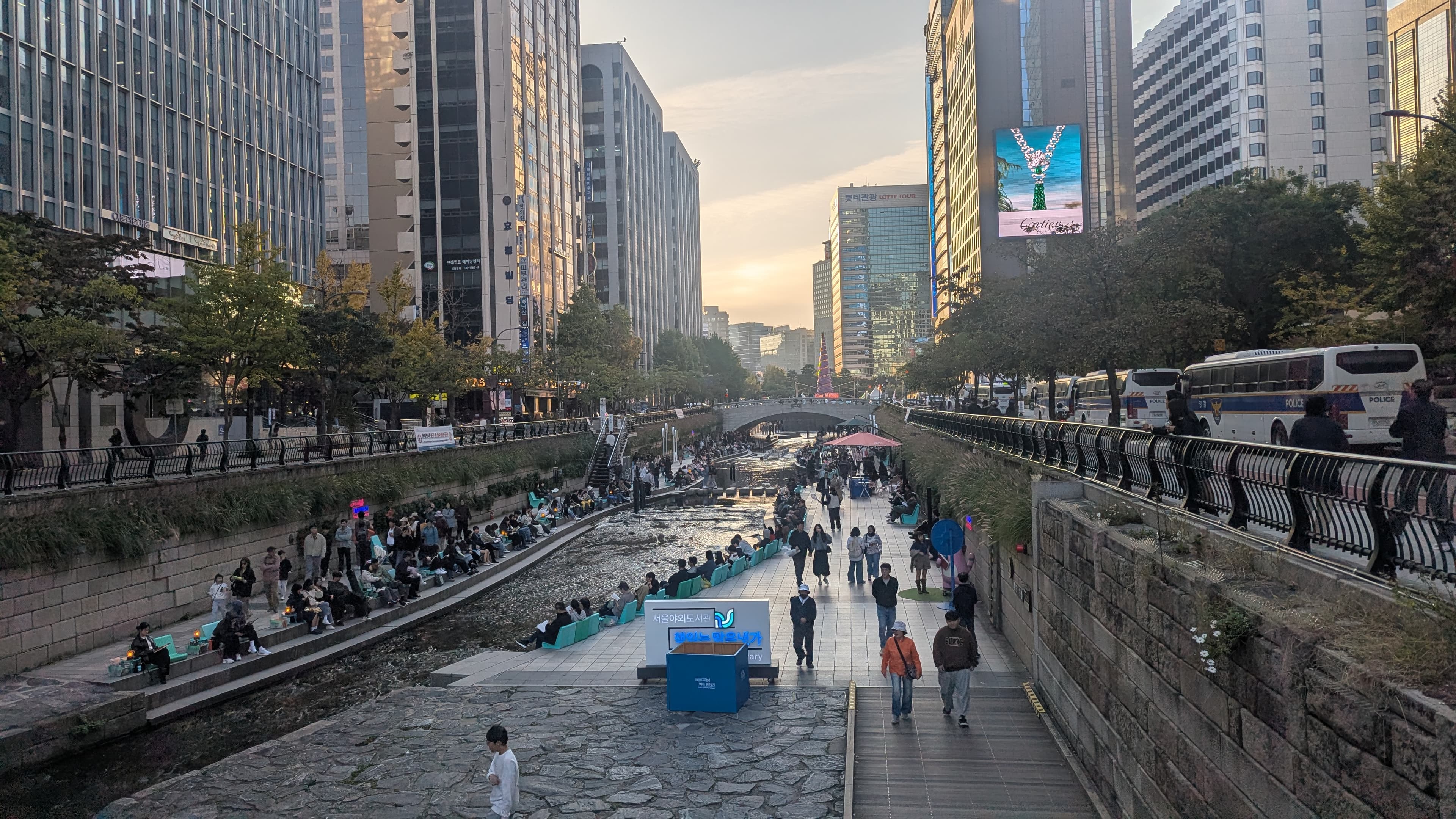
Cheonggyecheon.
Subtraction as design — sometimes the budget goes into what you remove.
the corridor before
Before
The Cheonggyecheon was never a wild river, and that fact matters for everything that follows. It was an engineered drainage stream running west‑to‑east through the heart of Hanyang — the city that became Seoul — and the Joseon court began rebuilding it as civic infrastructure almost as soon as the capital was founded. In 1406, King Taejong expanded the natural stream by dredging its bed and constructing embankments along both sides; the work became known as Gaecheon, literally “open stream.” In December 1411 the government established a temporary office, the Gaecheondogam, specifically to oversee maintenance. King Yeongjo, two and a half centuries later, made the upkeep a national project, dredging in 1760 and 1773 and straightening the curved waterway with stone embankments.
So “restoration” in 2003 was, from the start, restoration of a designed object— a watercourse with dredging cycles every two to three years, government-built bridges, and a permanent administrative office — not the restoration of an ecology. The distinction cuts both ways, and the case Saint Paul is making turns on it. The stream took its current name, Cheonggyecheon, “clear valley stream,” in 1914, during the Japanese occupation.
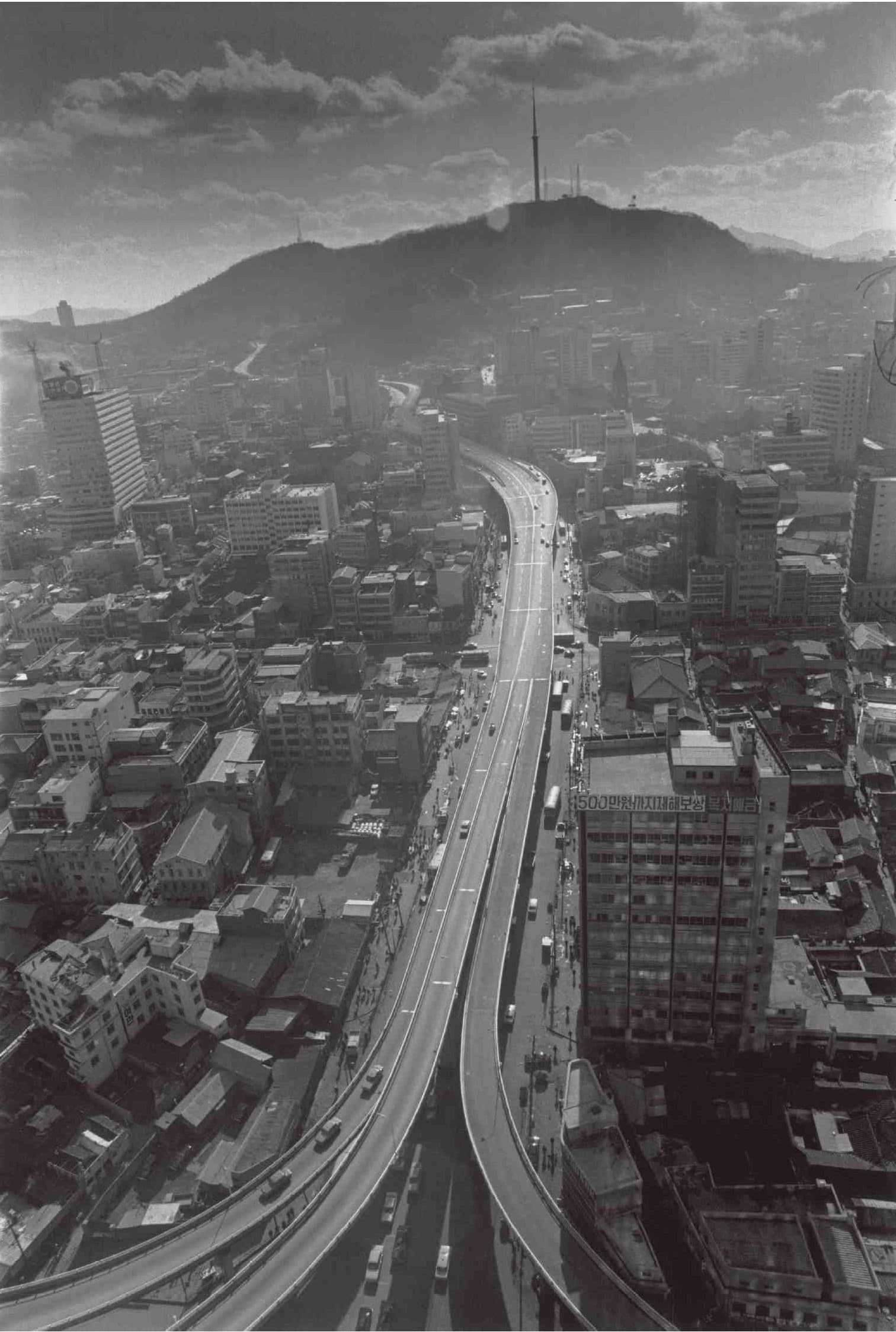
Then came the burial. Postwar Seoul was desperately poor and overcrowded, and the stream banks filled with shanties and refugees. Beginning in 1958 the city covered Cheonggyecheon in concrete across three sequential phases stretching into 1977. Atop the concrete, an elevated four‑lane structure — the Cheonggye Expressway, 5.6 kilometers long and 16 meters wide — was completed in 1976. The expressway was politically inseparable from the Park Chung‑hee modernization project; one urbanist review describes it, “similar in form to Seattle’s Alaskan Way Viaduct,” standing as “a symbol of successful industrialization and modernization of Korea.” Building the expressway was, in part, a way of demonstrating that Korea could build expressways at all.
By the late 1990s the road and the elevated deck together carried over 168,000 vehicles a day — 65,810 on the street-level road and 102,747 on the elevated expressway above it. The surrounding Dongdaemun corridor had densified into one of Asia’s largest informal wholesale and retail districts: the Hwanghak‑dong flea market, the Dongdaemun fashion‑wholesale zone, and street markets layered through the area. The expressway was both the lifeline and the ceiling of this commercial economy.
But the structure was rotting from underneath. In 1997 weight restrictions were imposed, permitting only smaller vehicles because of structural concerns. In 2000, engineers from the Korean Society of Civil Engineering completed a formal structural assessment and found the expressway to lack structural integrity — carbon monoxide, methane, and other gases accumulating at the sewer and drain level below the road had corroded the foundation. Repairs would have cost roughly US$95 million.
This is the primary‑source fact that most retellings lose. The expressway was not demolished because Seoul fell in love with ecology. It was demolished because it was failing structurally, the repair bill ran into nine figures, and a politically ambitious mayor saw the opening. Air quality along the corridor was also documented as severely worse than the citywide baseline — residents along the route were more than twice as likely to suffer respiratory disease as those elsewhere in the city. The 2000 KSCE report is the closest thing to a primary planning document in the public English‑language record, and it is consistently cited by Korean and international sources alike.
decision, timeline, cost
Build
The idea of restoring Cheonggyecheon had circulated among urban‑development experts for years before Lee Myung‑bak adopted it as his marquee mayoral campaign promise in the spring of 2002. During the spring election debates the restoration “became the object of a heated battle and fierce discussion, eclipsing all other election issues.” Lee — running as the conservative Grand National Party candidate, a former Hyundai Construction CEO — won by a substantial margin and shortly after his victory confidently announced that he would tear down the highway and renovate the stream, and that it would all be completed in just three years.
The political‑authorship dimension is the one Saint Paul should sit with. Lee made Cheonggyecheon hisproject. He attached his name and his political future to a fixed demolition window. Nearly 80 percent of Seoul residents supported the project at the time of the 2002 vote, but that support had to be operationalized — and Lee did the operationalizing personally.
He announced that he would tear down the highway and renovate the stream — and that it would all be completed in just three years.
— the promise Lee Myung-bak staked his term on
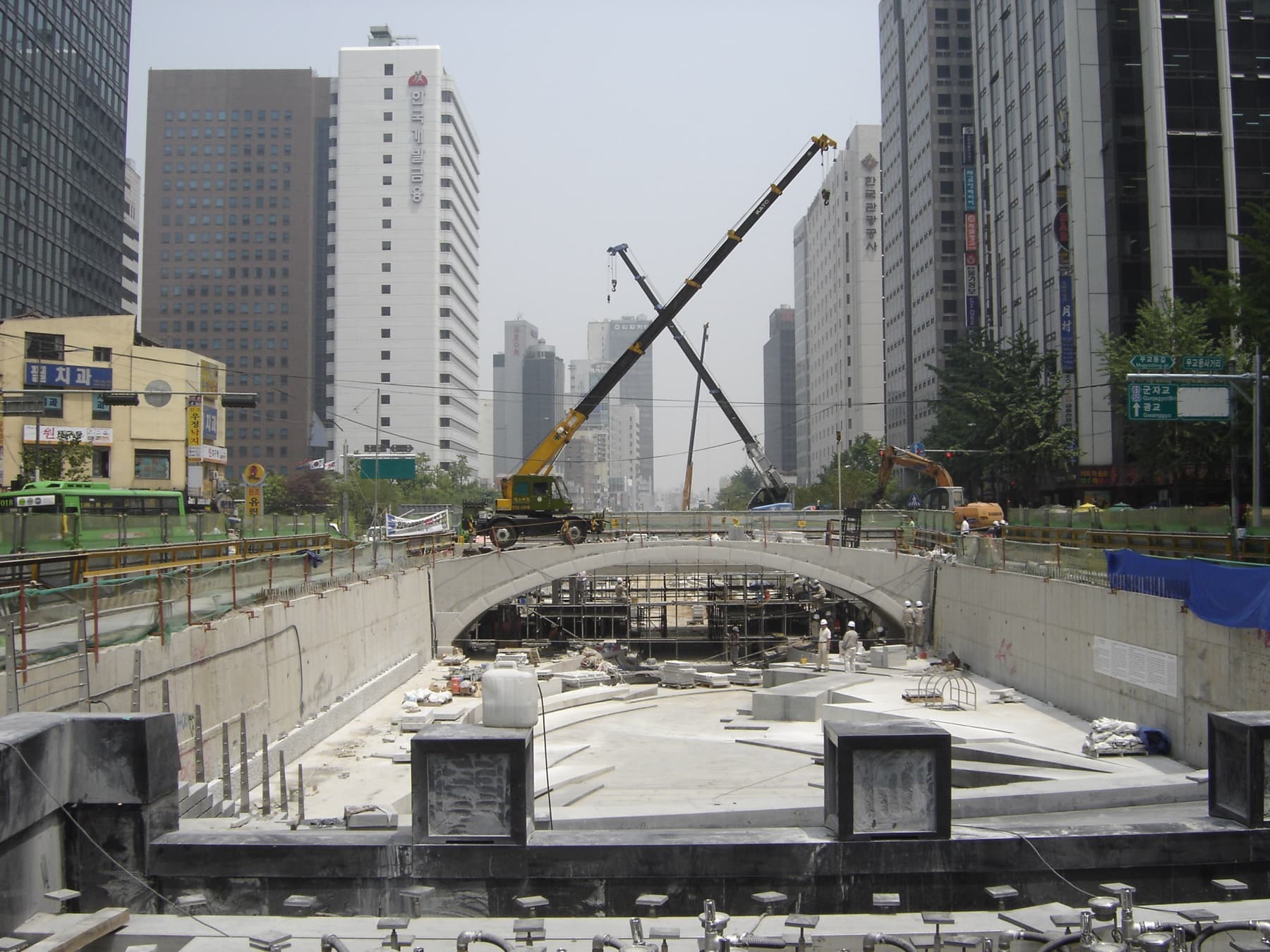
Demolition began July 1, 2003, the day Lee took office for his full term. The construction timeline was uncompromising: 27 months from demolition to opening. The sequenced milestones ran demolition in July 2003, the construction phase from September 2004, landscaping in May 2005, water supply and testing from June 2005, and a grand opening on October 1, 2005.
The project was budgeted at ₩349 billion and came in at over ₩386 billion — approximately US$281 million in 2003 dollars— for the 5.84‑kilometer restoration. The budget construction is itself instructive for any civic-scale project. Roughly ₩100 billion was repurposed from money already allocated to renovating the elevated highway — the city would have spent it on the expressway anyway. About ₩100.4 billion was saved by downsizing less‑urgent projects and tightening work procedures, ₩8.2 billion came from donations sponsoring specific bridges, and the remainder came from general accounting. The total was, by the city’s own reckoning, about 1 percent of the Seoul municipal budget. The deciding question was never whether the city had the money. The deciding question was political will and project sequencing.
The fiercest opposition came not from drivers but from merchants. More than 60,000 merchants and roughly 1,000 street vendors operated in the Cheonggyecheon and Dongdaemun commercial areas before the project. They saw the expressway as commercial infrastructure: the elevated road brought delivery traffic, the under‑deck space sheltered street markets, and the surrounding density meant foot traffic. Removing it meant 27 months of disruption and, more existentially, a city reorienting the corridor away from wholesale commerce and toward leisure and tourism.
By Seoul Metropolitan Government accounts, the city held roughly 4,200 meetings with affected merchants between 2002 and 2003. But the policy held to a principle of no direct compensation for business interruption or relocation. And in November 2003, the city forcibly evicted more than a thousand street vendors using approximately 8,000 public and hired personnel— the most violent number in the Cheonggyecheon story, and one almost entirely absent from celebratory English‑language coverage. The merchants were promised a future at a relocation scheme called Garden Five. That promise belongs to a later chapter, and it did not hold.
the arc through 2026
Compound
The most‑quoted statistic on Cheonggyecheon is correct and verifiable. Small‑particle air pollution along the corridor dropped 35 percent, from 74 to 48 micrograms per cubic meter, an improvement the Landscape Performance Series brief attributes to removing the paved expressway, the cooling effect of the stream, increased vegetation, fewer auto trips, and a modest rise in wind speeds moving through the corridor. Summer surface temperatures along the stream now run 3.3 to 5.9°C cooler than the parallel road four to seven blocks away.
Honesty requires the qualifier that the celebratory accounts drop. More granular pollutant data shows uneven results: sulfur dioxide fell 10 percent along Cheonggyecheon while neighboring areas fell 16 percent, and nitrogen dioxide fell 15 percent along the corridor while neighboring areas saw a 16 percent increase over the same window. The corridor got cleaner; some of its neighbors did not. A serious reading of the air-quality case holds both facts at once.
Cheonggyecheon now draws roughly 64,000 visitors a dayon average — on the order of 23 million a year — a figure that traces to the 2011 Landscape Performance brief and has not been authoritatively updated by the Seoul Metropolitan Government at the twenty‑year mark. The Congress for the New Urbanism cites about half a million visitors a week, consistent within rounding; other outlets cite 90,000 daily, which appears to count peak season. To mark the twentieth anniversary in 2025, the city opened the upstream section to the public for the first time in two decades and hosted the Water Seoul 2025 conference at City Hall.
The property story is large. Land values within 50 meters of the stream rose 30 to 50 percentin the years after the opening — double the rate of increase elsewhere in Seoul — with office rents up 13 percent and, in some adjacent redevelopment districts, land prices up 35 to 80 percent. The number of businesses in the corridor grew 3.5 percent during 2002–2003, double the downtown rate, and corridor employment rose 0.8 percent against a 2.6 percent decline in the rest of downtown Seoul. Total catalyzed redevelopment investment is estimated at ₩22 trillion (about US$1.98 billion)— a 57‑to‑1 ratio of induced investment to direct public outlay, if you accept the attribution model. The character of commerce shifted accordingly: small‑scale manufacturing and wholesale gave way to restaurants, cafés, design studios, and pedestrian‑oriented retail. That is gentrification by another name, and it is one of the costs.
The stream is also expensive to keep alive. From October 2005 through the end of 2016, maintenance and management totaled ₩85.7 billion, averaging about ₩7.1 billion per year— roughly US$5.5 million — a figure that has trended upward over time. The most‑cited line item is the water itself: the restored channel requires pumping some 120,000 tons of water a day from the Han River, because the stream is nearly dry without it, and the electricity to move that water averages about ₩800 million a year.
That pumping is the seam the Korean academic critique pulls on, and it is intellectually unavoidable. Professor Myung‑rae Cho of Dankook University framed the central dilemma — whether the project brought back an environmentally friendly civic jewel or produced a “fish tank” with an artificial water supply — and in a 2005 column titled “Cheonggyecheon Has Not Been Restored” he was blunter still: the stream is inherently a dry stream, which makes the pumped flow ecologically misleading.
The project treats the stream as an artificial landscaperather than a living ecosystem — what critics came to call the world’s largest fountain.
— on honesty about what a thing actually is
The comparison cases sharpen the point. Three freeway‑to‑park conversions recur in the literature alongside Cheonggyecheon: Boston’s Big Dig, which buried Interstate 93 downtown and laid the Rose Kennedy Greenway above it; the San Francisco Embarcadero, where the 1989 Loma Prieta earthquake gave the city the opening to demolish a double‑deck freeway and reconnect downtown to the waterfront; and Madrid Río, where Spain buried much of the M‑30 and built a linear park atop it along the Manzanares. Cheonggyecheon is distinctive in three ways: it removed the road outright rather than burying it, it was authored politically by a single mayor on a single term, and it was done at a fraction of the cost — Boston’s Big Dig consumed roughly $24.3 billion and Madrid Río about €4 billion, against Cheonggyecheon’s $281 million.
what happened to people
Residential impact
This is the chapter the celebratory accounts erase, and it is the one that maps most directly onto Saint Paul’s obligation to the people already using the Skyway. The Cheonggyecheon corridor sheltered an estimated 60,000 merchants and 1,000 street vendorsbefore construction began in 2003. Some operated in formal storefronts in the surrounding Dongdaemun and Hwanghak‑dong districts. Many — especially the street vendors — worked from beneath the elevated deck or on adjacent sidewalks, in semi‑formal arrangements that had run for decades.
The compensation was limited and contested. Across roughly 4,200 negotiation meetings between 2002 and 2003, the city held to a principle of no direct compensation for business interruption or relocation. Street vendors specifically were treated as ineligible because their activity was deemed illegal — they held no formal land tenure to compensate. In November 2003 the city forcibly evicted more than a thousand street vendors using approximately 8,000 public and hired personnel. That figure rarely appears in international urbanist coverage. It should.
Where the displaced went is the part that turns the “success” framing inside out. Street vendors who did not give up their businesses were first relocated to a flea market at Dongdaemun Stadium, which opened in January 2004 and was promoted as permanent. It was not: the stadium was demolished within five years for the Dongdaemun Design Plaza, displacing the vendors a second time. The vendors evicted in that 2008–2009 round were moved again, to the Seoul Folk Flea Market near Sinseol‑dong (the Sinseol‑dong Pungmul Sijang), which survives, though substantially reduced from its pre‑2003 footprint, and is now promoted by the Seoul tourism office as a heritage attraction.
The larger formal promise was Garden Five, a shopping complex built in southeastern Seoul’s Songpa District. The city offered relocation rights to 6,097 merchants who expressed interest. Only 1,028 completed the move — and by 2015, roughly one hundred remained. One Seoul chronicler characterizes Garden Five as “a debacle of unfinished promises and empty space.” It sat too far from the downtown commercial network the merchants depended on, and its rent and lot structure simply did not match street‑market economics. The scheme failed on its own terms.
The long‑term pattern is gentrification, documented and academically named. Real-estate values near the stream rose substantially — one zone nearest City Hall ran 14 to 29 percent above surrounding zones — and the corridor’s character shifted from small‑scale manufacturing and wholesale toward design studios, cafés, and tourism‑oriented retail. The lower‑income residents and small businesses who had occupied affordable spaces in the pre‑restoration neighborhood were progressively priced out. Subsequent Korean scholarship frames this as a recurring weakness of the country’s urban‑greening strategy, asking plainly whether the approach is socially inclusive.
Three administrations later, the verdict is rethinking, not reversal. Park Won‑soon, mayor from 2011 to 2020, did not undo Lee’s project. In March 2012 he launched a Cheonggyecheon Citizens’ Committee with an explicit critique: the original restoration had been too rushed, conducted without proper investigation of the stream’s status, and had produced an artificial stream where water must be supplied by electricity, with historic structures abandoned on grassy sites or improperly relocated. Park proposed an indefinite, citizen‑led re‑restoration, refusing a deadline and reaching for the longest analogy he could find.
Whether it takes tens or hundreds of years — slowly, thoroughly, and beautifully — like the Sagrada Família or Cologne Cathedral.
— Mayor Park Won-soon, launching the Cheonggyecheon Citizens' Committee, 2012
Park never delivered the re‑restoration. He died in July 2020, and the project was effectively shelved — unfinished. The net of three administrations is unambiguous: no Korean mayor has reversed the 2005 project, but the academic and civic critique — that it is a fountain, not a stream — has hardened into consensus. The displaced merchants were never made whole. That is the load‑bearing warning, and it is the one Saint Paul cannot afford to repeat.
for Saint Paul
The lesson
Cheonggyecheon’s most useful lessons for Saint Paul are not the obvious ones. They are about subtraction, honesty, and authorship — and one warning about who gets hurt.
The first is subtraction as design. Seoul did not add an amenity; it removed an expressway, and the removal wasthe design. The budget went into what got taken away. The Skyway is already a half‑mile aerial public space; the reclassification asks Saint Paul to recognize what it is by removing a category mismatch — the one that calls it a “private corridor with public easement.” Nothing is being built. The point is to legibly name what already exists.
The second is honesty about what the thing actually is. Cheonggyecheon’s most enduring damage was the rhetorical overclaim that it had restored an ecology when it had built a designed public stream fed by Han River pumps — what Cho rightly reframed as a designed public room that uses water as a material, not a restored ecology. The Skyway is not nature. It is not even outdoors. It is a designed indoor civic walking space that already functions as a transit‑leisure‑refuge hybrid for tens of thousands of Saint Paulites a year. Naming it a Linear Park is exactly the honest framing Cheonggyecheon got wrong by overclaiming — the framing Park Won‑soon spent eight years trying to correct.
The third is political authorship. Cheonggyecheon happened because Lee Myung‑bak signed his name to a 27‑month window and staked his standing on it. A category change inside a real‑estate‑and‑easement‑tangled corridor requires sustained will from a person, not from a committee — not because Saint Paul will demolish anything, but because legibility is itself a political act.
And then the warning, which is where Saint Paul holds an advantage Seoul did not. When the existing users of a corridor are reorganized, the city’s obligation to relocate and protect them is the moral floor of the project, not an afterthought. The merchants of Dongdaemun were evicted by 8,000 personnel, promised a Garden Five that took 6,097 down to a hundred, and never made whole. Saint Paul approaches the same question from the opposite posture: the reclassification displaces no one, removes no livelihood, and clears no market. The Skyway’s current users are not in the path of demolition because there is no demolition — only a name made honest.
Seoul spent its budget on what it removed.Saint Paul has nothing to remove — only a category to correct.
— the lesson Seoul paid for and Saint Paul can keep
That is the inheritance. Cheonggyecheon is the most‑cited freeway‑to‑public‑space conversion of the last quarter‑century, and the most contested. Its triumphs are real; its costs — the pumped water, the evicted vendors, the priced‑out blocks — are real too. Saint Paul can take the design logic without the demolition and the honesty without the overclaim, and protect the people already in the corridor from the beginning rather than the end.
Sources & further reading
Where this came from.
- Cho, Myung-rae. Restoring and Re-Restoring the Cheonggyecheon: Nature, Technology, and History in Seoul, South Korea — Environmental History 24(4) (2019)
- Cho, Myung-rae. 청계천은 복원되지 않았다 [Cheonggyecheon Has Not Been Restored] — Pressian (2005)
- Cheonggye Freeway — Congress for the New Urbanism — Freeways Without Futures
- Revitalizing a City by Reviving a Stream — Development Asia (Asian Development Bank) (2018)
- Robinson and Hopton. Cheonggyecheon Stream Restoration Project — Landscape Performance Series (Landscape Architecture Foundation) (2011)
- Lee, S.W. et al.. Analysis of Air Quality Change of Cheonggyecheon Area by Restoration Project — ResearchGate (2014)
- Lee, J.. Cheonggyecheon, Dongdaemun Gentrification: Artist's Note — Seoul Libre Maps (Medium) (2018)
- Discarding Highways: Cheonggyecheon Restoration — Encyclopedia of Wasting Well (2022)
- Seoul Urban Regeneration: Cheonggyecheon Restoration and Downtown Revitalization — Seoul Solution (Seoul Metropolitan Government policy archive)
- Cheonggyecheon Stream Restoration: The $281 Million Urban Renewal That Became a Global Model — Seoul Vision 2030
- Mayor Park Won Soon's Administrative Journal 09: Whether it takes tens or hundreds of years, Cheonggyecheon restoration is a Go — Seoul Metropolitan Government
- 20-Year Milestone of the Cheonggyecheon Stream Sets the Stage for Water Seoul 2025 International Conference — Seoul Metropolitan Government (2025)
- 20 years after restoration, stretch of Cheonggyecheon opens to public — Korea Herald (2025)
- Kim, Y. et al.. Rethinking Cheonggye Stream Restoration Project: Is urban greening strategy socially inclusive? — Land Use Policy (2023)
- Cheonggyecheon Restoration Project — Harvard Graduate School of Design, Urban Design Case Studies Archive
- Cheonggyecheon — Wikipedia
- 청계천 (Cheonggyecheon) — Wikipedia (Korean)